
Executive summary
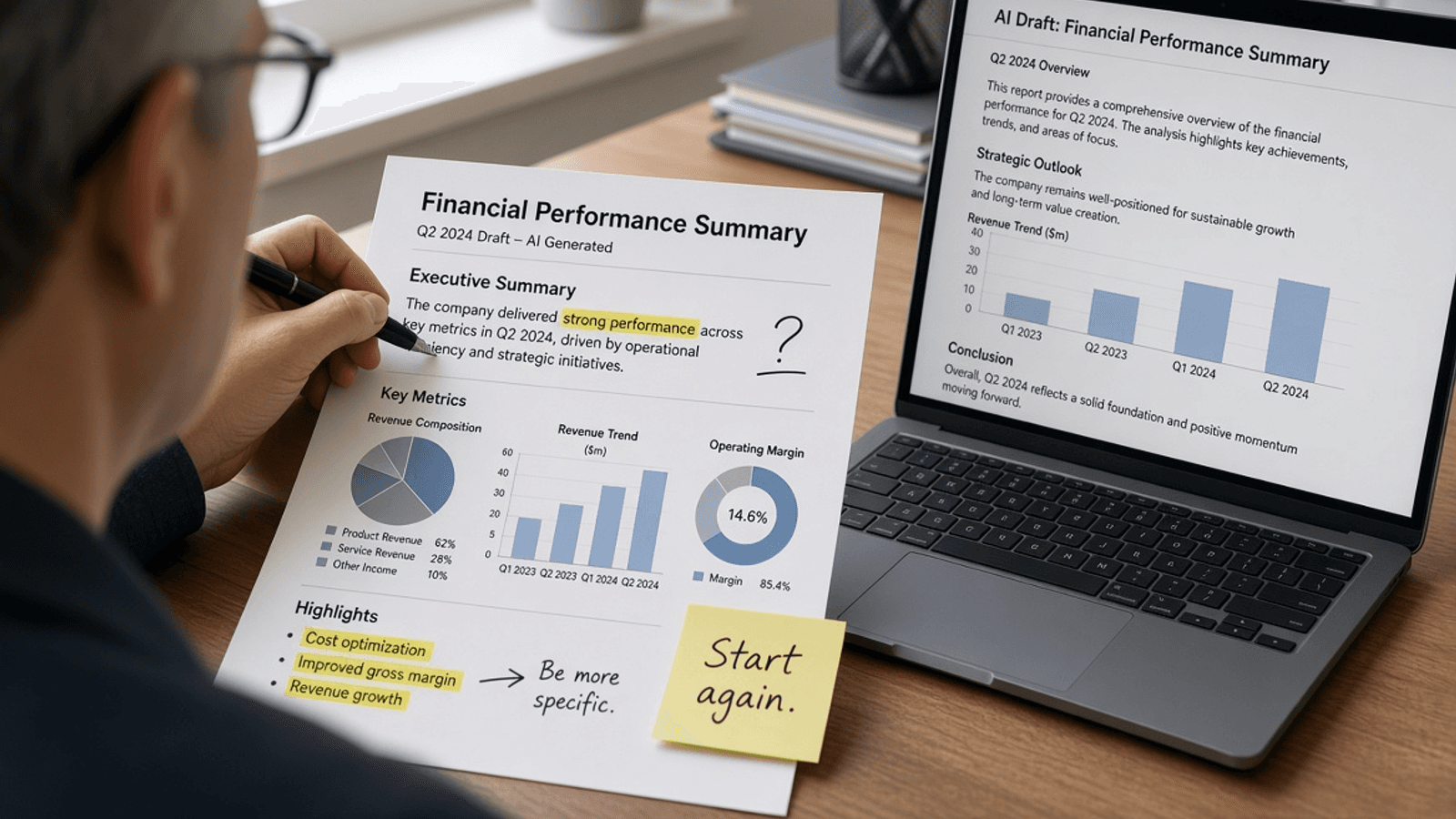
Workslop is low-effort, AI-generated work that can look finished at a glance but leaves the person who receives it to do the thinking. This post covers the research on it, what Australian courts and regulators have said about unchecked AI output, and how a firm can decide which work AI drafts and how closely it is reviewed.
If a document opens with "In today's digital landscape", or there is an em dash in every second sentence, you can usually tell straight away that AI wrote it.
Plenty of good work starts as an AI draft: a report outline, a client update, a first pass at an idea that needed fleshing out. AI gets people to that first version faster.
1What workslop is
The Macquarie Dictionary named AI slop its Word of the Year for 2025 and defines it as "low-quality content created by generative AI, often containing errors, and not requested by the user". Merriam-Webster chose slop a few weeks later, defining it as "digital content of low quality that is produced usually in quantity by means of artificial intelligence".
Workslop is the workplace term. Researchers at BetterUp Labs and the Stanford Social Media Lab coined it in the Harvard Business Review in September 2025, defining it as "AI generated work content that masquerades as good work, but lacks the substance to meaningfully advance a given task". In a January 2026 follow-up, they described it as "low-effort, AI-generated work that looks plausibly polished, but ends up wasting time and effort as it offloads cognitive work onto the recipient".
Workslop can be obvious from the first line, or it can look finished, with problems that only show on a closer read: a figure with no source, or a summary that says something slightly different from the document it came from.
The original HBR study surveyed 1,150 full-time employees in the United States. Of those, 40% said they had received workslop in the past month, and they estimated that 15.4% of the content they received at work fitted the description. Recipients reported spending an average of 1 hour and 56 minutes dealing with each instance, which the researchers costed at US$186 a month for each person receiving it. BetterUp, a coaching company, ran the survey with the Stanford researchers, and the results were published as a magazine article without peer review.
2How much gets checked
In the 2025 Victorian Lawyer Census, 36.7% of Victorian lawyers said they use AI tools in their practice. Of those who answered the questions on quality, 88.7% said they take steps to ensure accuracy, 76% cross-check the legal accuracy of the output against other sources, and 50% cross-check for hallucinations.
In a survey of 1,500 Australian digital workers run by the software vendor Glean, 44% said they sometimes deliver AI-assisted work they haven't fully checked.
Older research on processing fluency found that information that is easier to process can be judged as more true (Alter and Oppenheimer, 2009). A polished AI draft may benefit from the same effect, although that research was not about AI.
In clinical decision support, a review of 74 studies found that workload, task complexity and time pressure were associated with greater automation bias, which is relying on a system's output without checking it.
In their January 2026 follow-up, the researchers associated workslop with "unclear AI mandates and overwhelmed teams".
3What it costs a firm
In the original HBR survey, 40% of the workslop people received came from colleagues at the same level, and 18% went up the line to managers. About half of the people who received it saw the sender as less creative, capable and reliable, 42% saw them as less trustworthy, and 32% said they were less willing to work with that person again.
In August 2025, a senior barrister in Victoria apologised to the Supreme Court after defence submissions in a murder trial included made-up quotes from a speech in parliament and cases that did not exist. The submissions had also gone to the prosecutor, who did not check them either, and the ABC reported that the errors caused a 24-hour delay in the case.
Justice Elliott wrote in his ruling that "the ability of the court to rely upon the accuracy of submissions made by counsel is fundamental to the due administration of justice", and that "it is not acceptable for artificial intelligence to be used unless the product of that use is independently and thoroughly verified".
In Dey v Minister for Immigration and Citizenship (No 2), decided in the Federal Circuit and Family Court in September 2026, a solicitor admitted using generative AI for submissions that cited 11 authorities that did not exist. He was ordered to pay $9,600 in costs personally.
Deloitte wrote a report for the Department of Employment and Workplace Relations under a contract worth about $440,000. After a University of Sydney academic found fabricated references and a made-up quote attributed to a Federal Court judge, Deloitte agreed in October 2025 to repay the final instalment of its fee.
In a joint statement, the Victorian Legal Services Board and Commissioner, the Law Society of NSW and the Legal Practice Board of WA said AI tools "cannot be relied on as a substitute for legal knowledge, experience or expertise". LPLC, the professional indemnity insurer for Victorian legal practices, says responsibility rests with principals to "supervise and review all client work". Are you the human in the loop? looks at where review sits in the workflow.
AI Uplift Program
See how AI drafts are reviewed
The investigation shows where AI comes into your firm's work today and how it is reviewed. You keep the findings, whatever you decide.
4Deciding how closely AI drafts are reviewed
Some limits are set outside the firm. In the NSW Supreme Court, Practice Note SC Gen 23 says generative AI "must not be used in generating the content of affidavits, witness statements, character references" and similar evidence.
AI can draft a long report. You still need to read it through and understand it, and if a client or a partner asks you a question about it, you need to be able to answer. In the same Glean survey, 45% of those surveyed reported "shipping work they couldn't explain if asked".
Group the work by review requirement.
An agenda or dictated notes turned into a memo may only need tidying. Client letters, reports and anything with a figure or an authority in it need reading line by line. Some work stays with a person from the first word, including anything the courts, your regulator or your clients have ruled out.
Use the question test.
Before anything leaves a desk, the person sending it should be able to answer a question about any paragraph in it. If they can't, it goes back for another read.
Set a length and a voice.
Set the expected length and voice for common documents, such as a file note, a client email and a report summary, rather than accepting the tool's default. Brand guidelines do this for a firm's name and logo, and the same idea carries over to AI drafts.
Say what AI did.
A line between colleagues, such as "AI drafted this, and I have checked the figures and section 3", tells the reader where to look. Whether a note like this goes to clients is a separate call. In the Victorian Lawyer Census, 63% of the lawyers surveyed agreed that AI use should be disclosed to clients.
Make room for checking.
Make it an explicit step in the workflow and allow time for it.
Without a shared approach
- No shared rule for AI drafting
- Review depth varies
- AI contribution unclear
- Checking competes with other work
- No common standard for final ownership
With a shared approach
- Work grouped by review requirement
- Review requirement agreed
- AI contribution identified where useful
- Checking included in the workflow
- Sender can explain and stand behind the final work
5Where we come in
Our investigation maps where AI drafts come into your firm's work, who reviews them, and how long each step takes today. The findings belong to your firm whether or not we go any further together.
If you would like to work out how AI drafts should be reviewed in your firm, reach out to our team. The first conversation works out whether your firm is the right fit for the AI Uplift Program, and whether we are the right people to help.
Reviewing AI drafts
Frequently asked questions
What is workslop?
A term coined by researchers at BetterUp Labs and the Stanford Social Media Lab, in the Harvard Business Review in September 2025, for "AI generated work content that masquerades as good work, but lacks the substance to meaningfully advance a given task".
Is workslop the same as AI slop?
They overlap. The Macquarie Dictionary defines AI slop as low-quality content created by generative AI, often containing errors and not requested by the user. Workslop is the researchers' term for low-effort AI-generated work that can look finished but leaves the recipient to do the thinking.
How much time does workslop cost?
In the original HBR survey of 1,150 US employees, recipients reported spending an average of 1 hour and 56 minutes dealing with each instance. The results were published as a magazine article without peer review.
What can make unchecked AI output easier to accept?
Research outside generative AI suggests two possible mechanisms. Information that is easier to process can be judged as more true, and in clinical decision support, workload, task complexity and time pressure were associated with greater reliance on a system's output.
How can a firm reduce workslop?
Group work by how closely AI drafts need reviewing, make sure the sender can answer questions on anything that goes out, set the expected length and voice for common documents, say what AI did in a draft, and make checking a step in the workflow.

About the author
Julia leads the investigation and is the author of the report presented to your leadership. Her background is in research, data analysis and business strategy.
Primary sources
Macquarie Dictionary, Word of the Year 2025, 24 November 2025macquariedictionary.com.auMerriam-Webster, slop, dictionary entry, and Word of the Year 2025, 15 December 2025merriam-webster.comNiederhoffer, Kellerman, Lee, Liebscher, Rapuano and Hancock, AI-Generated "Workslop" Is Destroying Productivity, Harvard Business Review, 22 September 2025hbr.orgNiederhoffer, Robichaux and Hancock, Why People Create AI "Workslop" and How to Stop It, Harvard Business Review, 16 January 2026hbr.orgAlter and Oppenheimer, Uniting the tribes of fluency to form a metacognitive nation, Personality and Social Psychology Review, 2009 (foundational)doi.orgGoddard, Roudsari and Wyatt, Automation bias: a systematic review of frequency, effect mediators, and mitigators, Journal of the American Medical Informatics Association, 2012 (foundational)doi.orgVictorian Legal Services Board and Commissioner, Generative AI Use in the Legal Profession: Findings from the 2025 Victorian Lawyer Census, April 2026lsbc.vic.gov.auGlean, Work AI Index 2026: Australia, 3 August 2026 (vendor survey)glean.comDirector of Public Prosecutions v GR [2025] VSC 490, Supreme Court of Victoria, 14 August 2025austlii.edu.auABC News, Senior lawyer apologises after filing AI-generated submissions in Victorian murder case, 15 August 2025abc.net.auDey v Minister for Immigration and Citizenship (No 2) [2026] FedCFamC2G 1799, Federal Circuit and Family Court of Australia, 14 September 2026austlii.edu.auInformation Age (ACS), Deloitte to refund government over AI errors, 7 October 2025ia.acs.org.auVictorian Legal Services Board and Commissioner, Law Society of NSW and Legal Practice Board of WA, Statement on the use of artificial intelligence in Australian legal practice, 6 December 2024lsbc.vic.gov.auLPLC, Supervising AI, updated 11 May 2026lplc.com.auSupreme Court of New South Wales, Practice Note SC Gen 23: Use of Generative Artificial Intelligence, commenced 3 February 2025supremecourt.nsw.gov.auThis article is general information about how firms organise their use of AI. It is not legal advice, and any policy drawn from it should be finalised by your firm.